
What Google’s Discovery Engine Reveals About the Future of SEO and the Secrets Behind the 7 New Ranking Signals: Why This Matters Now
Search isn’t what it used to be. The classic model, ‘type a keyword and get ten blue links,’ is fading. In its place, we’re seeing a new paradigm emerge: a search experience powered by AI.
At the heart of this shift is what Google Cloud Discovery Engine (also referred to as “Vertex AI Search”) reveals about how modern AI-led search works under the hood.
Thanks to insights shared by industry observers like Metehan Yeşilyurt, we now have a rare, tangible glimpse into the system powering AI-driven search: the underlying architecture, the ranking signals, chunking logic, and the signal‑fusion mechanism.
If you’re serious about staying visible and competitive in SEO over the next 2–5 years, this isn’t optional. It’s essential.
In this post, I break down what we know today, why it matters for businesses and marketers, and what you should do to align your content and digital strategy with this new reality.
Table of Contents
1. How Google’s AI Search Pipeline Seems to Work
2. What This Means in Practice: A New SEO Playbook
3. Why This Transparency from Google Matters
4. Potential Risks & What to Watch Out For
5. Conclusion: The AI‑First SEO Era Is Here, and It Demands Both Strategy & Content Craftsmanship
How Google’s AI Search Pipeline Seems to Work (Based on Discovery Engine)
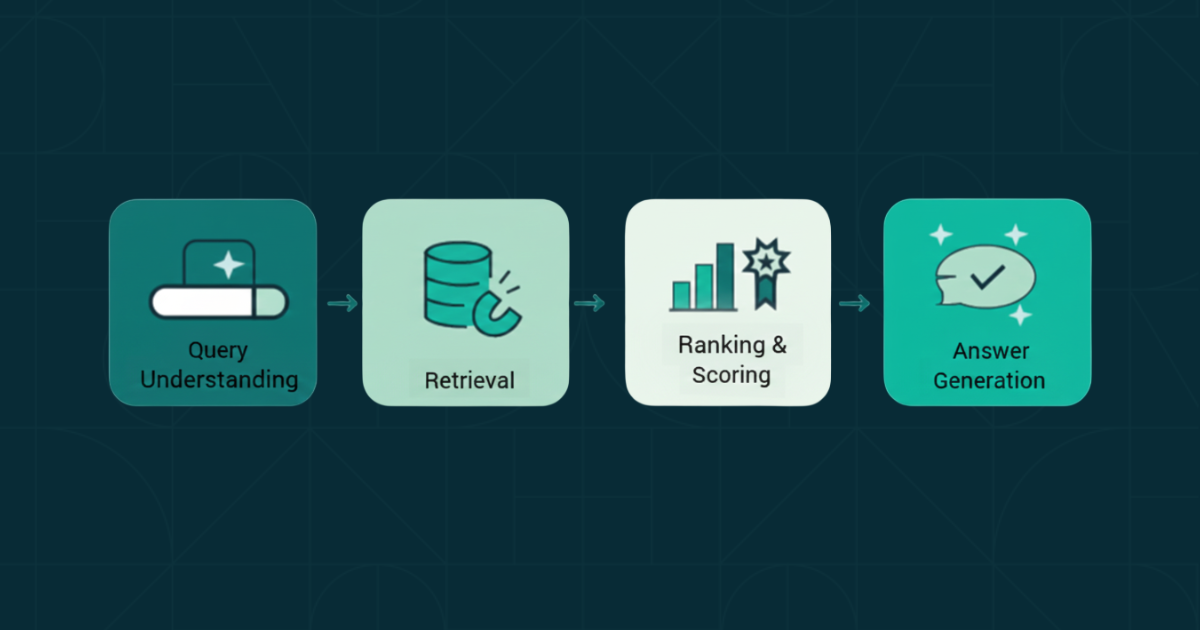
Metehan’s write‑up suggests Google isn’t winging this behind closed doors. There’s a structured, four‑stage pipeline powering its AI search and ranking behaviours. Here’s how it appears to function:
| Stage | What Happens | Why It Matters to You |
| Prepare / Query Understanding | User queries are normalised, contextualised, expanded — synonyms, autocomplete options, query reformulation, etc. | Keywords alone no longer cut it. Your content must cover the broader semantic field, including related terms, alternative phrasing, and evolving lingo. |
| Retrieve / Document Selection & Chunking | System pulls candidate documents and breaks them into chunks — roughly ~500 tokens each (≈ 350–400 words), preserving heading context if configured. | Your content must be structured in modular, self‑contained “chunks” (with H2/H3s, clear sub‑sections, concise paragraphs) to survive chunk‑level retrieval. |
| Signal / Ranking & Scoring | Retrieved chunks are evaluated based on up to 7 ranking signals (see below). | SEO today is multidimensional — from semantic relevance to engagement and freshness. You need a holistic content strategy. |
| Serve / Answer Generation | Top‑scoring chunks are fed into LLMs (e.g. Gemini) for synthesis into user‑facing responses — summaries, conversational answers, AI‑Overviews. | The best content doesn’t just rank — it gets cited, summarised, and shown as the “answer.” That boosts brand authority even in zero‑click contexts. |
This is far more than “SEO with AI sprinkling.” It’s a fundamental shift in how content is discovered, evaluated and delivered.
The 7 Signals Powering AI‑Mode Ranking (and What You Should Do About Them)
According to the publicly exposed “Signal Viewer” in Discovery Engine (as highlighted by Metehan), here are the seven key signals — along with what they mean for content strategy.
| Signal | What It Measures | Strategic Implication |
| 1. Base Ranking | The baseline relevance score (similar to old‑school SEO ranking) | Maintain strong technical SEO: fast site, crawlable pages, robust site structure — core foundation matters. |
| 2. Embedding‑Based Semantic Similarity (“Gecko Score”) | Vector‑based semantic proximity between query intent and content | Content must be semantically deep — cover related topics, synonyms, context. It’s not just about hitting keywords but matching concepts. |
| 3. Cross‑Attention Semantic Relevance (“Jetstream Score”) | Contextual understanding: negation, nuance, relationships — handles “not”, “without”, “vs”, comparative queries better than embeddings alone | Write clearly. Anticipate intent. Explain what is and isn’t. Address comparisons directly (“pros vs cons”, “alternatives”, “why choose X over Y”). |
| 4. Traditional Keyword Matching (e.g. BM25) | Classic keyword-to-content matching | Keywords remain relevant but only as one of several signals. Don’t abandon them, but also, don’t rely solely on them. |
| 5. Engagement & Predicted User Interaction (PCTR / Personalised CTR) | Likelihood of click or engagement based on historical & predicted behaviour | Optimise for real users: readable content, strong UX, clear value. Engagement signals matter more than ever. |
| 6. Freshness / Recency | New or recently updated content is often given priority (especially on time‑sensitive topics) | Regularly update content. For evergreen topics, include a “last reviewed/updated” timestamp. For evolving topics (e.g. laws, tech, trends), prioritise freshness. |
| 7. Boost/Bury (Manual or Rule‑Based Overrides) | Allows overrides based on quality, brand authority, and manual rules — important for enterprise or trusted‑source preference | Establish authority & trust: About page, credentials, reviews, authoritative references. Treat your site as a brand, not just a content factory. |
What This Means in Practice: A New SEO Playbook

1. Structure Content in Modular Chunks
- Use clear headings (H2/H3) not just for readability, but for AI retrieval logic.
- Keep each “chunk” around 300–400 words if possible, self‑contained and coherent.
- Use bullet lists, short paragraphs, tables, and clear formatting to make extraction easier for AI.
In short: think like a content engineer, not a blogger.
2. Fill the Semantic Field, Not Just Keywords
- Expand topics broadly: cover synonyms, related concepts, comparisons, FAQs.
- Use natural language context: imagine how different users might ask the same question differently.
- Build content clusters: core page + multiple supportive pages exploring subtopics, variations, and edge-cases.
3. Write for Real Humans, But Optimise for AI Logic
- Use clear language. Avoid unnecessarily complex sentences or over‑industry jargon.
- When addressing comparisons or negations (e.g. “vs”, “without”, “not”), do so explicitly. AI’s semantic models (like Jetstream) are more sensitive to this than traditional keyword matching.
- Provide evidence, data, sources or citations whenever possible, as this helps build trust and enables AI to verify credibility.
4. Keep Content Fresh, Especially on Time‑Sensitive Topics
- Regularly review and update content (especially for legal, regulatory, tech, and trending topics).
- Add “last updated” timestamps to pages — better for freshness signal and for user trust.
- Consider supplementary follow-up posts that dive into developments, context shifts, or related questions (ideal for an AI follow‑up-answer format).
5. Build Real Engagement & Brand Trust Signals
- Encourage genuine user engagement (comments, shares, dwell time), which feed into predicted‑engagement signals.
- Include brand, author credentials, about pages, and trust indicators (testimonials, case studies, social proof).
- For enterprise‑level clients, structured data (schema, entity markup) is more important than ever.
Why This Transparency from Google Matters
Until recently, much of search optimisation felt like guesswork. We observed correlations, tracked rankings, made hypotheses. But with the exposure of Discovery Engine’s inner workings, much of that guesswork becomes strategy.
Here’s why this matters big time for you as a business leader or marketing manager:
- You no longer optimise blindly
You can prioritise structural quality, semantic depth, engagement, and freshness with real reasoning behind it.
- It levels the playing field for good content
Smaller sites with well‑crafted content stand a chance against legacy domain authority if they align with these signals.
- It future‑proofs your content
SEO isn’t just about keywords or links anymore — it’s about building content assets that endure, adapt, and stay relevant as AI search grows.
- It creates a new value paradigm
Visibility may no longer be clicks but citations, trust, and brand presence in AI‑driven responses. That’s a branding and authority play — especially valuable for SMEs and niche enterprises.
Potential Risks & What to Watch Out For
No system is perfect. Even with these insights, there are uncertainties and risks we need to consider:
- The weighting of signals may change. What’s true today may evolve. Over‑optimising for one signal could be risky if Google shifts priorities.
- Niche or contrarian content could struggle. Semantic similarity + consensus bias may mean unique or dissenting perspectives are less likely to surface.
- Over‑engineering vs. human‑centrism. There’s a risk of creating content that reads well to AI — but poorly to humans. Always keep user experience front and centre.
- Scale & resource challenge for SMEs. Structuring content as modular chunks, updating frequently, managing engagement — good content at this level takes discipline and resources.
Conclusion: The AI‑First SEO Era Is Here, and It Demands Both Strategy & Content Craftsmanship
The Discovery Engine revelations show us that Google’s AI search logic isn’t magic; it’s engineering. It’s transparent. It’s structured.
For business owners and marketing leaders, this represents a once‑in‑a‑generation opportunity. If you adopt a content strategy built on semantic clarity, structured architecture, engagement, freshness and brand trust, you don’t just adapt to the future of search. You lead it.
At NetStripes, that’s exactly the kind of forward‑leaning, AI‑aware SEO strategy we’re championing for Aussie SMEs.
To learn more about how we can help get your business’s seo on track, book a free consultation with our SEO specialist here.